Rieger Brothers · opus 763 · 1899
Church of the Visitation of Our Lady, Etyek
A one-manual organ with ten stops, built by Rieger Brothers as opus 763 in 1899. It is on my list, but I have not recorded it yet.
This text was generated by AI from curated notes and may contain errors. Corrections welcome
The church
The Catholic church of Etyek is dedicated to the Visitation of Our Lady; its Hungarian name is Sarlós Boldogasszony-templom.
- The medieval church of Etyek was built in the mid-14th century. In 1717 it was consecrated to the Visitation of Our Lady.
- At the end of the 18th century Swabian (German-speaking) settlers came to the village, and the old church, with room for about 200 people, became too small.
- The present church was built in 1814–1816 on an artificially raised mound, to plans by József Rieder, master builder of Székesfehérvár. It was blessed on 6 October 1816 and then consecrated by the bishop of Székesfehérvár.
- The neo-baroque church is 34 metres long and 14 metres wide; its tower is 43 metres high.
- The church was renovated in 1934, in the 1980s and after the earthquake of January 2011.
The organ
According to Ferenc Solymosi's Rieger opus list, Rieger Brothers (Gebrüder Rieger) built this organ in 1899 as opus 763, with mechanical key and stop action and cone chests. The "Opus 763" plate on the console matches it. The organ has not been altered since 1899.
- Builder
- Rieger Brothers
- Opus
- 763
- Built
- 1899
- Manuals
- 1, with pedal
- Stops
- 10: 8 on the manual, 2 in the pedal
- Action
- Mechanical
- Recording
- Not recorded yet
Stops and playing aids
The Etyek organ has exactly the stops and playing aids of the Rieger organ in the small Catholic church of Mór, opus 796 of 1900, as printed in András Dékány's study of mechanical Rieger organs. I compared them on 28 October 2026. Mór was built a year after Etyek, 33 opus numbers later.
| Stop |
|---|
| Manual C–f³, 54 notes |
| Bourdon 16' |
| Principál 8' |
| Födött 8' (Gedackt) |
| Gamba 8' |
| Salicionál 8' |
| Octava 4' |
| Dolce 4' |
| Mixtúra 3 sz. 2 2/3' |
| Pedal C–d¹, 27 notes |
| Szubbaß 16' |
| Oktávbaß 8' |
- Coupler
- Pedál-coppel, manual to pedal.
- Combinations
- Mezzo-forte and Forte. Which stops they draw is not known yet.
- Other
- Crescendo u. decrescendo. What it does is not known yet.
The names are those printed for Mór. My photo of the Etyek console is too blurred to read every label letter by letter.
According to Dékány, the Mixtúra has three ranks: 2 2/3', 2' and 1 1/3' at C, breaking back to 4', 2 2/3' and 2' at c³.
Whether any stops share their pipes is not known yet. Rieger often built combined stops, in which one rank serves two stops an octave apart, and according to Dékány the most common pairs were exactly those of this stoplist: Principál 8' and Octava 4', Födött 8' and Bourdon 16', Salicionál 8' and Dolce 4', Szubbaß 16' and Oktávbaß 8'. His table marks none of the Mór stops as combined, but he did not examine that organ himself. In Kolárovo, whose Rieger organ of 1896 has exactly these ten stops, the Slovak organ catalogue's survey found the two 4' stops, the Bourdon 16' and the 8' pedal stop borrowed. A combined Bourdon of Rieger's starts only at the second C of the keyboard, so the lowest octave of the Bourdon 16' is the first thing to check.
What the console photo shows
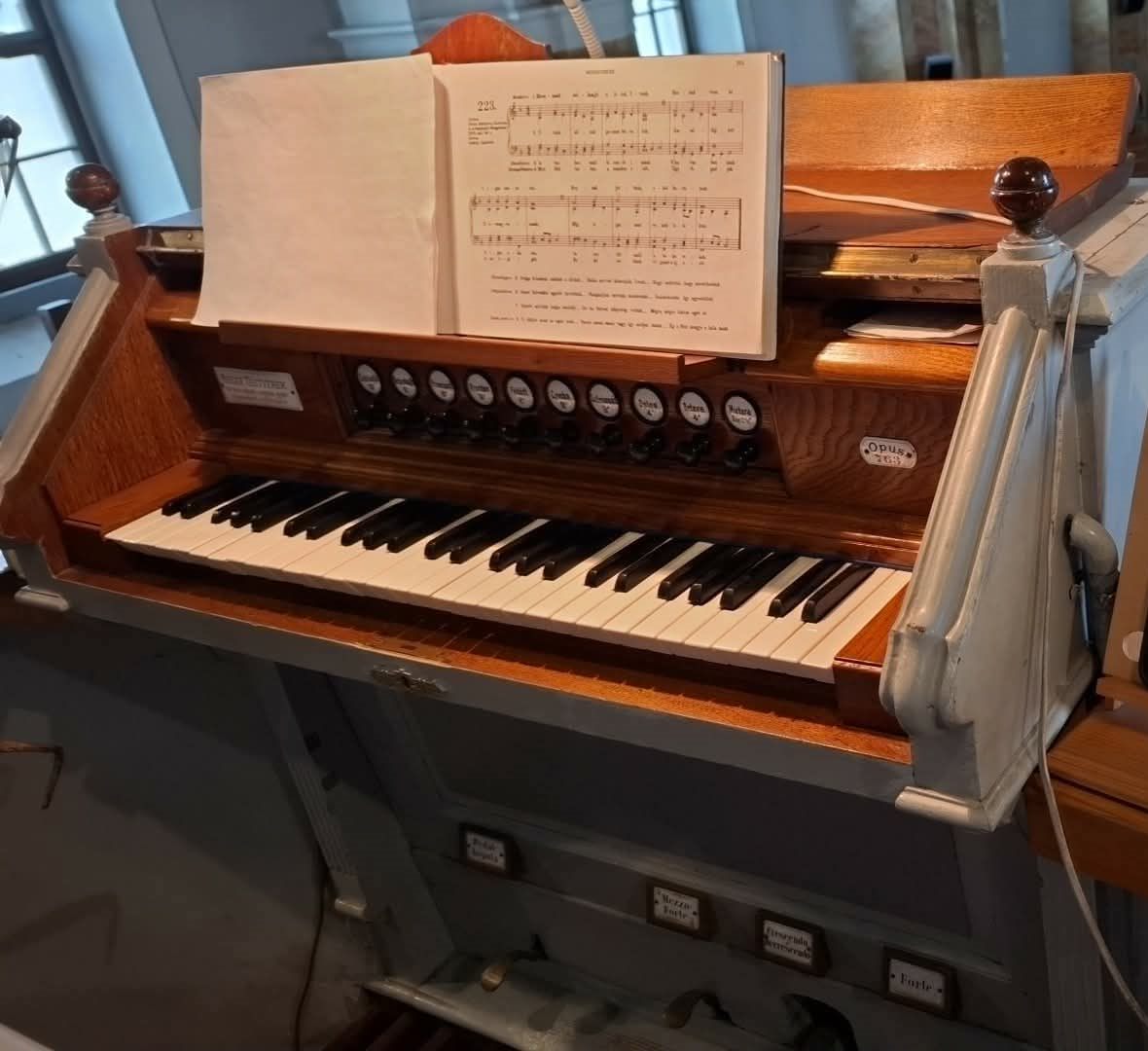 (larger photo)
- One manual and a single row of ten stop knobs. The last knob reads "Mixtura".
- An "Opus 763" plate, which matches the opus list.
- Four foot tabs under the keyboard, reading "Pedal koppel", "Mezzo forte", "Crescendo decrescendo" and "Forte" (the accents and hyphens are not legible). They match the playing aids in the Mór list.
Organs with the same or a similar stoplist
Rieger built this ten-stop organ more than once. Mór and Kolárovo have exactly the same stops; Csanytelek and Boldog differ only slightly. I have compared only the Mór stoplist with Etyek myself; the others come from Dékány's study and the Slovak organ catalogue. The Szentpéter organ on my own list is a two-manual relative: it has these ten stops plus a Csucsfuvola 8' and a Cello 8', with the Octava 4', Dolce 4' and Bourdon 16' borrowed in the same way.
-
Checked
Mór, Hungary
The same stops and playing aids, in the small Holy Cross church. Dékány marks none of them as combined, but he did not examine the organ himself.
Dékány's study, page 446 (opens in a new tab) (in Hungarian) · Church on Google Maps (opens in a new tab)
-
Not yet checked by me
Kolárovo, Slovakia
The same ten stops, with mechanical action and cone chests. The catalogue's survey found the Octava 4', Dolce 4', Bourdon 16' and the 8' pedal stop borrowed; the Bourdon has no pipes in its lowest octave.
Slovak organ catalogue, archived copy (opens in a new tab) (in Slovak) · Church on Google Maps (opens in a new tab)
-
Not yet checked by me
Csanytelek, Hungary
The same eight manual stops, with a Cello 8' added in the pedal. Dékány marks the Bourdon 16' (from the second C), the Octava 4', the Dolce 4' and the 8' pedal stop as combined.
Dékány's study, page 446 (opens in a new tab) (in Hungarian) · Church on Google Maps (opens in a new tab)
-
Not yet checked by me
Boldog, Hungary
Very similar: an extra Rohrflöte 4', a Cello 8' instead of the 8' pedal stop, and the stopped 8' called Gedeckt. Dékány surveyed this organ himself and marks the Bourdon 16' (from the second C), the Octava 4' and the Dolce 4' as combined.
Dékány's study, page 446 (opens in a new tab) (in Hungarian) · Church on Google Maps (opens in a new tab)
Still to find out
- The exact Etyek spelling of the ten stop labels, the builder's nameplate and the four foot tabs.
- What "Crescendo u. decrescendo" controls, and which stops "Mezzo-forte" and "Forte" draw.
- Whether any stops share their pipes with another rank.
Sources
- Ferenc Solymosi: the Rieger opus list (opens in a new tab) (PDF, in Hungarian)Magyar Egyházzene VIII (2000/01), with the Etyek entry on page 132.
- András Dékány: the mechanical Rieger organs (opens in a new tab) (PDF, in Hungarian)Magyar Egyházzene VIII (2000/01), 439–476, with the stoplist of Mór, opus 796, on page 446 and the Etyek Mixtúra on page 472.
- Etyek Catholic parish: booklet about the church, 2026 (printed, in Hungarian)Found in the church; the source of the church history above.