A recording project
Recording the organs of three villages
Five organs in three villages. For each of them I want a Hauptwerk sample set that keeps the organ as it is: its real tuning, the differences between pipes, natural attacks and releases, and the church acoustics, not an idealised version.
This text was generated by AI from curated notes and may contain errors. Corrections welcome
Villages and organs
The project covers three villages and five organs: three in Biatorbágy (two in Bia, one in Torbágy), one in Etyek and one in Szentpéter (Svätý Peter, Slovakia). The first one I recorded is the Rieger organ of St. Anna, Bia.
-
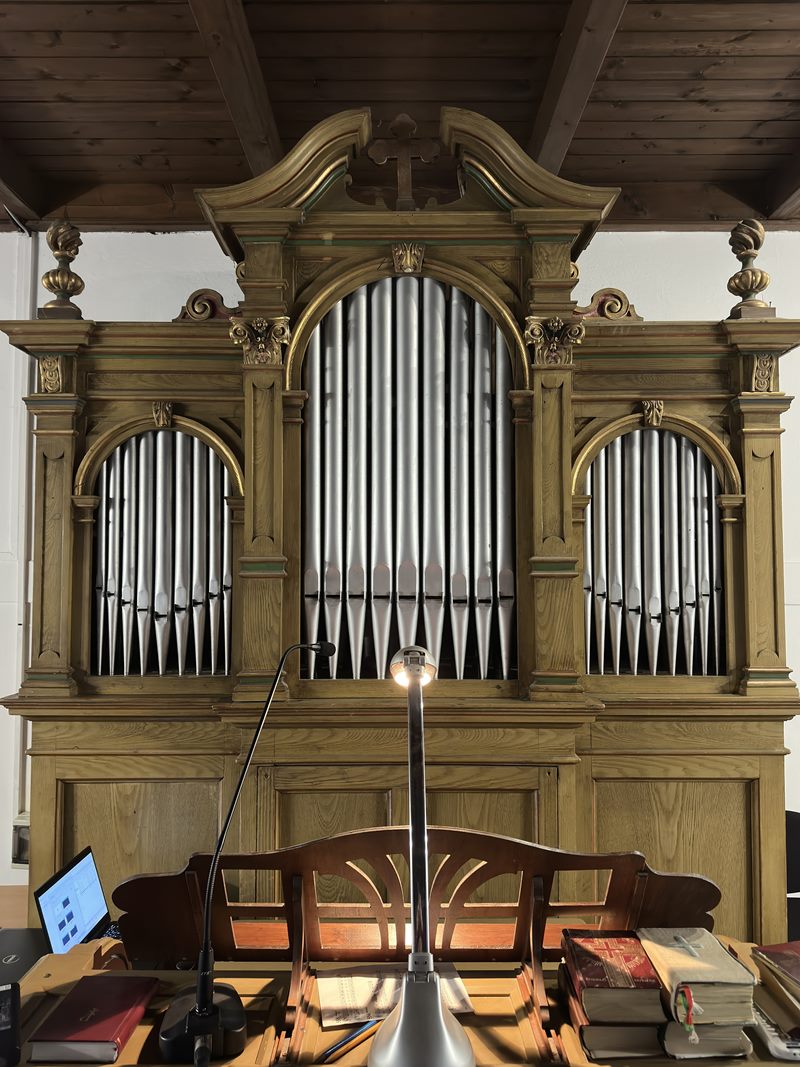 Rieger · opus 1614 · 1910St. Anna, BiaThe 1910 Rieger organ, opus 1614, of St. Anna Church in Bia, Biatorbágy: the church, the instrument, the recording of every pipe and a first sample set for Hauptwerk 4.Recorded · first trial
- Rieger · opus 1251 · 1905TorbágyThe one-manual Rieger organ, opus 1251, of the Church of the Holy Name of Mary in Torbágy, Biatorbágy: what I know so far. Not recorded yet.Not recorded yet
- Reformed Church, BiaThe Reformed Church of Bia, built in 1710, is one of the oldest buildings of Biatorbágy. According to the Rieger opus list, its organ is a one-manual Rieger of 1912, opus 1811. Not recorded yet.Not recorded yet
-
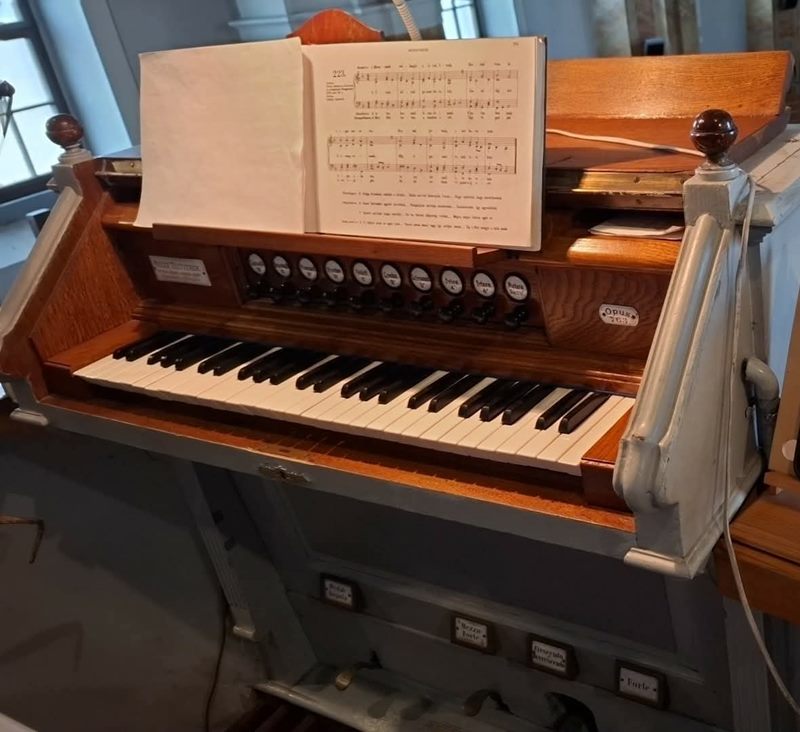 Rieger Brothers · opus 763 · 1899EtyekThe one-manual Rieger Brothers organ of 1899, opus 763, in the Church of the Visitation of Our Lady, Etyek: ten stops, the stoplist of its sister in Mór.Not recorded yet
-
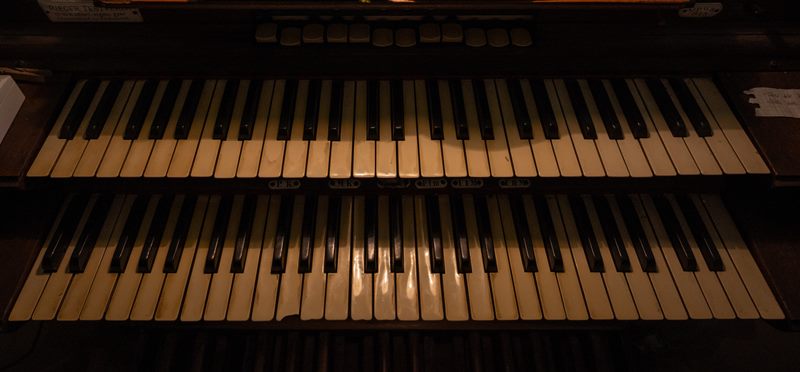 Rieger Brothers · opus 815 · 1900SzentpéterThe two-manual Rieger Brothers organ of 1900, opus 815, in St. Martin Catholic Church, Szentpéter (Svätý Peter, Slovakia): twelve stops, four of them borrowed from other ranks. Not recorded yet.Not recorded yet
How I record
The method so far comes from the first organ, the Rieger of St. Anna, Bia.
- Every physical pipe is recorded once, one note at a time. Stops that borrow pipes from another rank are not recorded twice, only their extra pipes; a borrowed rank (8' plus its 4' extension) is recorded as one continuous take.
- Per note: hold 10 s, then about 5 s of silence, longer where the reverberation needs it: about 15 s per pipe. Keys and pedals are pressed and released gently.
- Room tone with the blower on and off, for the noise profile and the blower sound.
- A stereo pair of microphones, with all selectable processing switched off (noise cancellation, automatic gain, voice processing, audio enhancement). The equipment is tested at home first with held notes of at least 10 s.
- The microphone positions and levels are tested in the church; then position and gain stay the same for the whole session.
- Audacity, 48 kHz stereo, 32-bit float; the final samples are 24-bit WAV files.
- Masters are never changed; all work is done on copies.
- Audacity for cutting and noise reduction, LoopAuditioneer (opens in a new tab) for loops, release cues and pitch metadata, and Hauptwerk for playing. The recorded pipes are not retuned, and there is no compression or limiting. Later, on copies: a short fade at the very end of each sample, and level corrections and short local filters only where a problem was heard.
- The Hauptwerk console follows the real one. Digital aids that the organ does not have are labelled as such and start switched off; controls whose function is not known, such as fixed combinations, stay inactive instead of being guessed.
The first session in Bia, on 24 October 2026, did not yet follow all of this: the microphones turned out to be unsuitable, I waited longer between notes, and the treble extensions were recorded separately. See what went wrong.
AI help, and where it stops
AI helps with the finishing work: ChatGPT/Codex wrote and ran the processing programs and edited the Hauptwerk files. The audio work is ordinary signal processing only: no generative audio and no neural noise reduction. Generative image editing is used only for decorative console artwork, never for documentary photos. I listen to the results and make the decisions.
The recording timer
The recording timer is a full-screen cue display that alternates timed “silence” and “hold note” phases for the organist. My first session used its default of 10 s for both phases: 10 s of sound, 10 s of silence. 10 s of sound and 5 s of silence is enough, so for my plan set the silence phase to 5 s.
Open the recording timer (opens in a new tab) (in English).
What I have learned so far
From the first recording, in Bia in 2026.
Before the session
- Test the microphones with long held notes before going to the church, and check the recording, not only the indicator lights. My wireless system made almost every note start loud and then drop by 5–8 dB, and I only found out afterwards.
- A compensating volume curve can make such a recording usable as a first trial, but it cannot bring back the real attack. Better recordings are the only real fix.
In the church
- Press and release keys and pedals gently: hard playing adds action noise that is hard to remove later.
- Record a borrowed rank and its treble extension in one take; separate takes make the level jump at the boundary.
- I waited longer between notes than needed. Next time: 5 s of silence after a 10 s note, longer for the pipes and places where the reverberation lasts longer. Never cut off useful reverberation.
- Microphone position matters more than processing afterwards: closer to the organ gave a much better signal-to-noise ratio than a distant recording cleaned up later.
- Avoid clipping, but do not record needlessly quietly: after amplification, microphone and blower noise become prominent.
- Record a room tone with the blower off as well as on.
Editing the samples
- Start each sample 20–50 ms before the pipe speaks. A longer lead-in becomes key delay in Hauptwerk.
- Put the release cue at the very first moment of the decay; a late cue makes the release sound cut off.
- Never trust automatic pitch detection blindly, especially in the bass: it can lock onto an octave, a harmonic or a subharmonic.
- Keep the real tuning in the WAV metadata instead of retuning the audio.
- Two good long loops per pipe are enough; choose them by ear, not by score.
- One careful noise-reduction pass from the original is better than several passes on top of each other.
- Do not boost noisy recordings a lot just to match levels; lower the loud ones instead.
- Edit WAV files with tools that keep the loop, cue and pitch data; a generic re-export can drop them.
In Hauptwerk
- Balance the ranks only when all of them are in Hauptwerk.
- Wrong pitch metadata is worse than an out-of-tune pipe: measure every rank and compare it with its neighbours.
- Automatic checks do not replace loading and listening in Hauptwerk. Rebuild the sample cache after editing WAV files.
- Mark reconstructed samples and rejected experiments clearly, so that they are not mistaken for recordings or reused by accident.