Rieger Brothers · opus 815 · 1900
St. Martin Catholic Church, Szentpéter
A two-manual Rieger Brothers organ with pedal, built in 1900 as opus 815 for the Catholic church of Szentpéter (Svätý Peter, Slovakia), dedicated to St. Martin. It is on my list, but I have not recorded it yet.
This text was generated by AI from curated notes and may contain errors. Corrections welcome
The church
Szentpéter, Svätý Peter in Slovak, is a village in the Komárno District of Slovakia. According to the Magyar Katolikus Lexikon, a parish existed here by 1332, and its church was dedicated to St. Peter, which gave the village its name. The present Catholic church, dedicated to St. Martin of Tours, was built in 1737.
The organ
- Builder
- Rieger Brothers
- Opus
- 815
- Built
- 1900
- Manuals
- 2, with pedal
- Stops
- 12, 4 of them borrowed
- Action
- Mechanical key action, pneumatic stop action
- Recording
- Not recorded yet
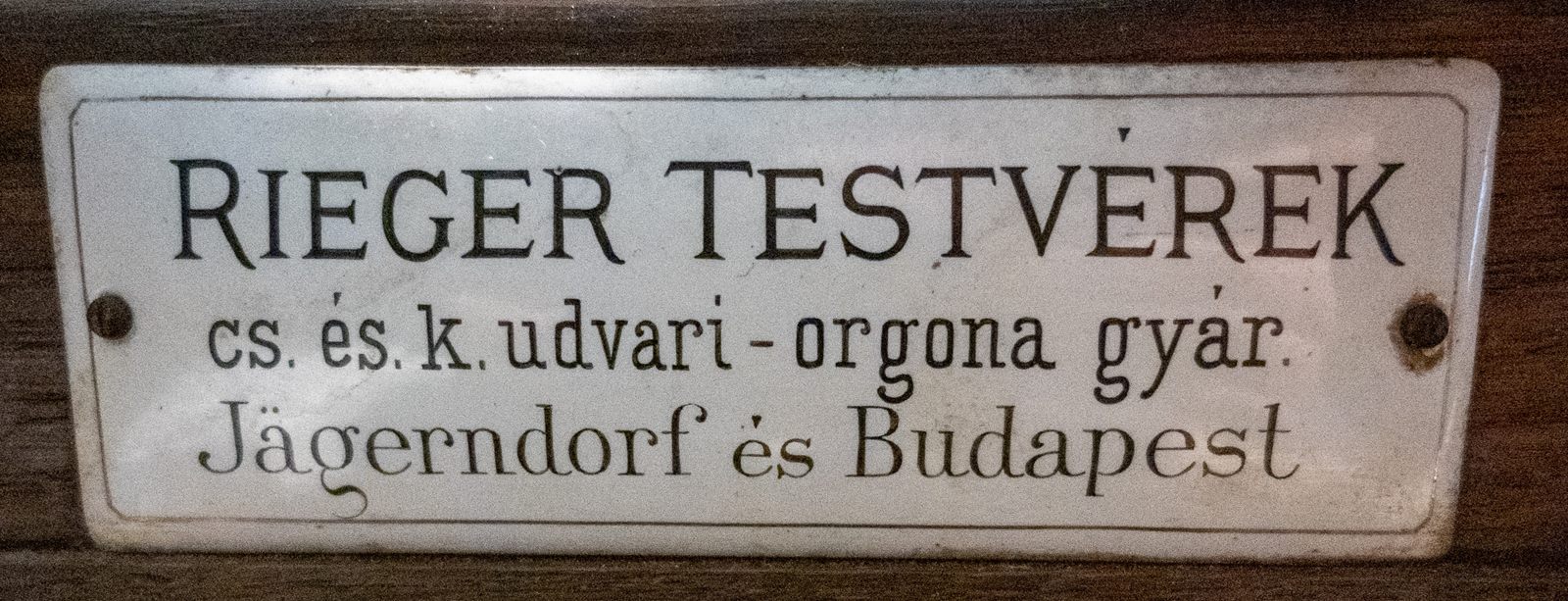
The nameplate on the console reads, in Hungarian, RIEGER TESTVÉREK cs. és k. udvari-orgona gyár. Jägerndorf és Budapest
: Rieger Brothers, imperial and royal court organ factory, Jägerndorf and Budapest. The opus plate reads 815.
According to the Slovak organ catalogue, Rieger built the organ new in 1900, and Rieger's own opus list has it as op. 815 Szt. Péter b. Komorn
. The key action is mechanical, the stop action pneumatic, and the chests are cone chests. During the First World War the façade pipes were requisitioned; they were replaced later with zinc pipes. When the catalogue surveyed the organ in 2002, it had not been rebuilt. I have not checked these details on site yet.
Stops and playing aids
The stoplist from the Slovak organ catalogue, with the names as they are written on the console and where each stop takes its pipes from.
| Stop | Pipes |
|---|---|
| Manual I C–f³, 54 notes | |
| Bourdon 16' | The Födött 8' (Gedackt) rank an octave lower; its lowest octave has pipes too |
| Principál 8' | Its own rank; part of it stands in the façade |
| Födött 8' | Its own rank |
| Gamba 8' | Its own rank |
| Octava 4' | The Principál 8' rank an octave higher, plus 12 treble pipes of its own |
| Mixtura 3 sz. 2 2/3' | Three ranks of its own: 2 2/3', 2' and 1 1/3' at C, breaking back a fifth at c³ |
| Manual II C–f³, 54 notes | |
| Csucsfuvola 8' | Its own rank |
| Salicionál 8' | Its own rank |
| Dolce 4' | The Salicionál 8' rank an octave higher, plus 12 treble pipes of its own |
| Pedal C–d¹, 27 notes | |
| Subbass 16' | Its own rank |
| Octavbass 8' | Not known yet (see below) |
| Cello 8' | Not known yet (see below) |
The names are those on the console, as the catalogue's technical description gives them; I cannot read them in my photo. The pedal chest could not be reached in the survey: according to the technical description, the Octavbass 8' is probably the Subbass 16' rank an octave higher, with 12 pipes of its own, while the catalogue's stoplist marks the Cello 8' as the borrowed stop.
- Couplers
- P.K., pedal coupler; M.K., manual coupler.
- Fixed combinations
- F.t.m., forte for the whole organ; F.I.M., forte on manual I; F.II.M., forte on manual II.
- Other
- Tremolo, a small red knob to the right of the stop tabs.
What the console photos show
 (larger photo)
 (larger photo)
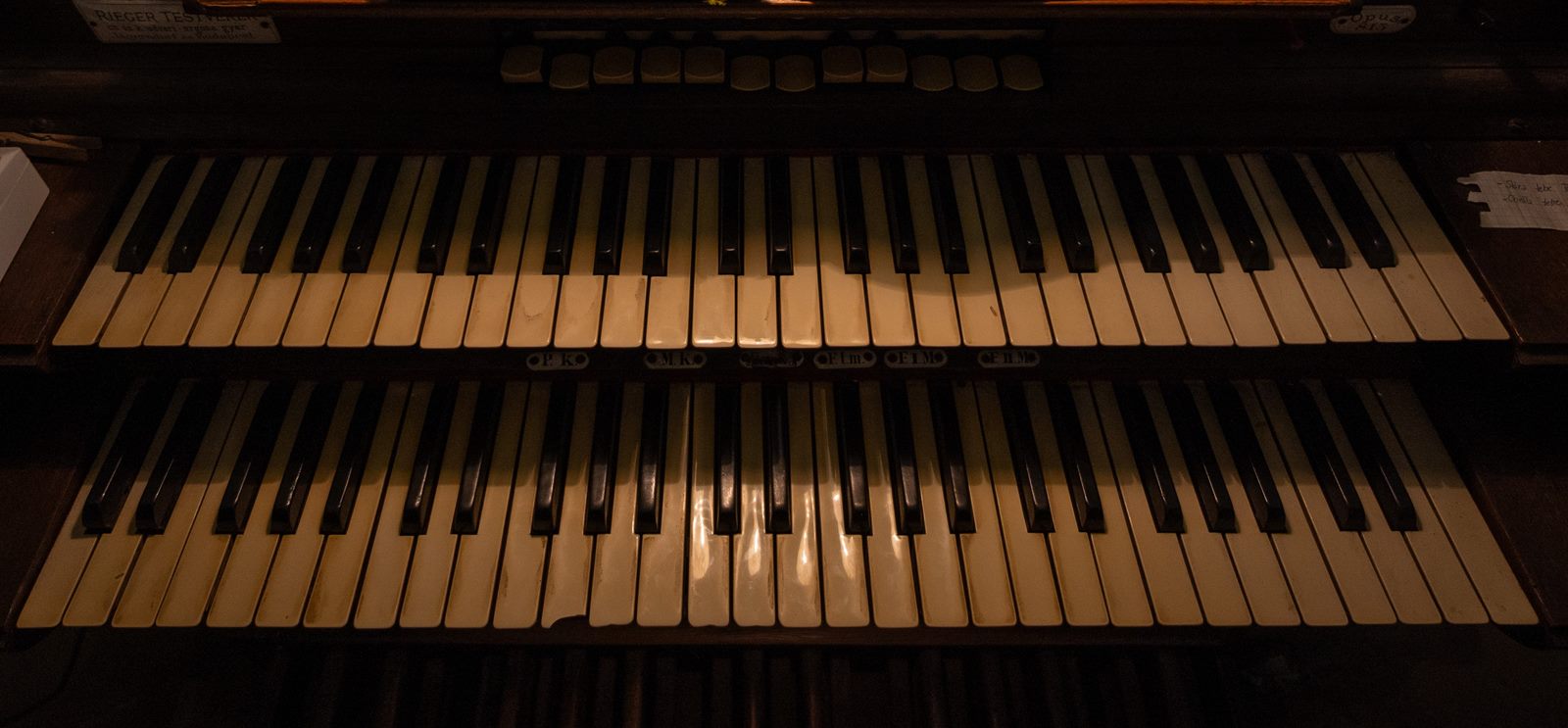
- The upper keyboard is manual II, the lower one manual I. Above them is a row of 12 stop tabs, one for each stop; the stop names, on round discs above the tabs, cannot be read in the photo.
- Six labels between the manuals. From left to right they read P.K., M.K., a third label that cannot be read, F.t.m., F.I.M. and F.II.M. The buttons themselves cannot be seen in the photo; according to the catalogue, P.K., M.K. and F.II.M. each have a black and a white button, the others one button each.
- Five of the labels match the two couplers and the three combinations in the catalogue. The catalogue could not read the third label either; it suggests, with a question mark, that its black button is a cancel.
- To the right of the stop tabs are a small red knob, the opus plate and a black button. The red knob is the Tremolo; the catalogue describes it as a later addition. The black button is original and was used to call the bellows pumper: it worked a small pump that sounded a single pipe at the back of the organ through a hose, the signal to start pumping.
Organs with the same or a similar stoplist
I have not found an organ with exactly this stoplist yet. These three Rieger organs of the same years, all in today's Slovakia, come closest; their data come from the Slovak organ catalogue alone. The Etyek organ on my own list has the same stops on a single manual, without the Csucsfuvola 8' and the Cello 8'.
-
Not yet checked by me
Ludrová, Slovakia
Built the same way: two manuals and pedal with 6, 3 and 3 stops, mechanical key action, pneumatic stop action and cone chests. The buttons between the manuals are laid out alike, with a single black button beside the two forte combinations. The stops differ in part, and all have their own pipes. The organ came here from Bohemia in the late 1960s.
Slovak organ catalogue, archived copy (opens in a new tab) (in Slovak) · Church on Google Maps (opens in a new tab)
-
Not yet checked by me
Dvory nad Žitavou, Slovakia
Two manuals and pedal with 6, 3 and 2 stops, fully mechanical, with cone chests. As in Szentpéter, the console stands in the gallery parapet, and the playing aids are the two couplers and fortes for manual I, manual II and the full organ, here with German names. Four stops are borrowed.
Slovak organ catalogue, archived copy (opens in a new tab) (in Slovak) · Church on Google Maps (opens in a new tab)
-
Not yet checked by me
Strekov, Slovakia
Twelve stops from eight ranks with Hungarian names, among them a Bourdon 16', a Mixtura 3 sz. of the same composition (2 2/3', 2' and 1 1/3'), Gamba 8', Salicionál 8', Subbass 16' and Cello 8'. Four stops are borrowed, as in Szentpéter, among them the Oktáva 4' from the Principál 8' and the Dolce 4' from the Salicionál 8'. Pneumatic action; the manuals have 6 and 4 stops.
Slovak organ catalogue, archived copy (opens in a new tab) (in Slovak) · Church on Google Maps (opens in a new tab)
Still to find out
- The label and use of the third button between the manuals.
- Which of the two 8' pedal stops is the borrowed one.
Sources
- Slovak organ catalogue: Svätý Peter, Kostol sv. Martina, archived copy (opens in a new tab) (in Slovak)Survey of 2002: history, stoplist and technical description. The catalogue itself is offline at the moment.
- Slovak organ catalogue: technical description of the organ (PDF), archived copy (opens in a new tab) (in Slovak)Console, actions, wind chests and pipes, from the same survey.
- Magyar Katolikus Lexikon: Komáromszentpéter (opens in a new tab) (in Hungarian)