St. Anna, Bia
What went wrong, and what I learned
The first session taught me a lot. Some problems, such as the level drop of the microphones, only showed up later, when I worked with the samples.
This text was generated by AI from curated notes and may contain errors. Corrections welcome

Loud start, quieter sustain
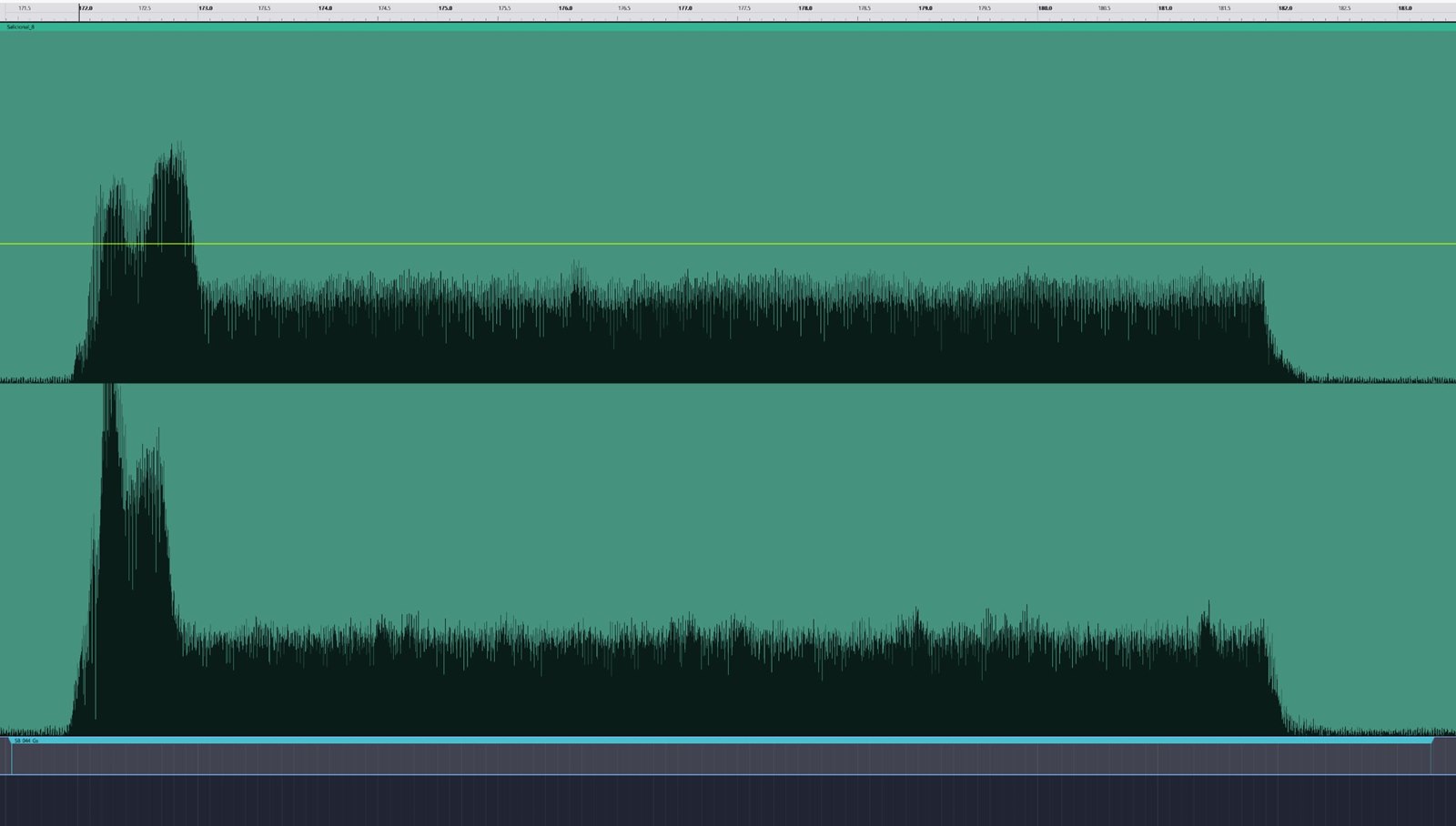
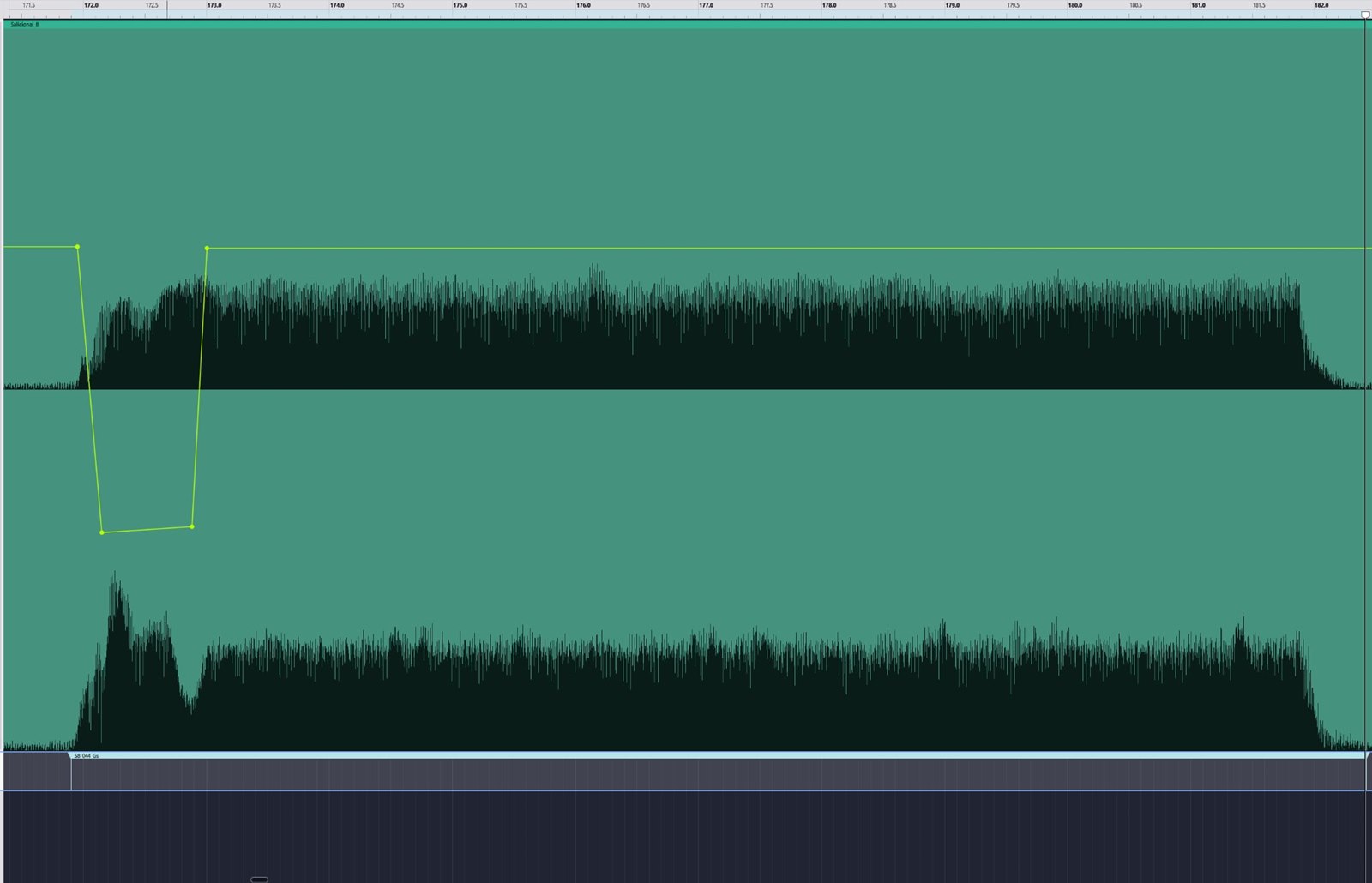
Almost every sample starts loud and then drops to a quieter sustain, and the release continues from the quieter level. Measured on all 213 raw recordings, the drop has a median of 5–6 dB per rank and is at least 3 dB in 205 of them. Raising the gain only made the attacks louder too.
At home I played the pipe organ voice of a Yamaha YDP-165 digital piano through the BOYALINK (opens in a new tab), on a computer and on a phone: the tone dropped by about 5–8 dB after about one second, while the phone's own microphone stayed steady. So the problem is in the BOYALINK recording path. The exact cause is not known, and the manual describes no automatic gain mode.
 (larger photo)
 (larger photo)
My decision: this microphone system is not suitable for sampling sustained pipes. To make the first trial usable, the samples of all four ranks got an attack correction, the Födött 8' (Gedackt) and Subbass 16' samples a 6 dB dip over the first 1.5 seconds (see the finishing work). It cannot bring back the real attack.
What I learned: test the microphones before going to the church, with long held notes, and check the recording itself: indicator lights and settings are not enough. Next time
Blower noise and a quiet level
The blower is clearly audible, because the BOYA (opens in a new tab) microphones are fairly noisy and the level was low: the lowest Subbass C peaks at about −29 dBFS. Two noise-reduction passes on top of each other still left it audible. Better: one careful pass from the original recording, without trying to remove every trace, because too much reduction sounds metallic or “underwater”. I did not use a 50 Hz notch filter, because the Subbass has real notes around 49–55 Hz. And I made no room-tone recording with the blower off.
What I learned: avoid clipping, but do not record needlessly quietly, and record the room tone with the blower on and off. Next time
Pressing too hard
I pressed keys and pedals harder than needed, and that added action noise. Short “chirp” noises at the start of a few notes probably come from it; I filtered them out locally.
What I learned: press and release keys and pedals gently and evenly. Next time
A separate take for the Dolce's 12 pipes
Recording the Dolce's 12 treble pipes of its own in a separate take made their level jump against the rest of the rank: I had to lower these 12 pipes by about 12–25 dB.
What I learned: record a rank and the extra pipes of a stop borrowed from it in one take. Next time
Timing: sample start, release and pauses
- My first samples started 0.5–1 s before the pipe sounded. Hauptwerk plays a sample from its first moment, so this became 0.5–1 s of delay on every key. A sample now starts only 20–50 ms before the pipe speaks.
- My first release cues were a little late, and the pipes sounded cut off when a key was released: I had zoomed in too far in LoopAuditioneer and did not see the whole waveform. The cue now sits at the very first moment of the decay. On a Subbass pipe one cycle lasts about 31 ms, so 30–50 ms is audible. Next time I will keep the zoom at a scale that shows the whole waveform.
- I waited longer between notes than needed: 10 s of silence after each 10-second note, the recording timer's default. This made the session and the editing longer; 5 s of silence is enough.
Pitch detection in the bass
Automatic pitch detection can be badly wrong in the bass. For the lowest Subbass C the three methods gave 31.4, 16.3 and 19.1 Hz; the real pitch was about 32.2 Hz.
Correct pitch metadata matters as much as the recording. I never retune the recorded pipes; instead, each WAV file stores the measured pitch of its pipe, and Hauptwerk relies on that value. A pipe that really is out of tune is therefore no problem, as long as the stored value describes it: the organ is not tuned to equal temperament at A = 440 Hz, and that lowest Subbass C sounds at about 32.2 Hz instead of the nominal 32.7 Hz. A wrong stored value, on the other hand, puts the note out of tune in Hauptwerk: one Principal f was stored as about 184 Hz while it sounds at about 172.7 Hz. I have corrected it; see the finishing work.
Boosting quiet notes
Do not boost noisy recordings a lot just to match their levels: the noise comes up with them. My try of raising quiet Salicionál notes by up to 27 dB made the hiss too loud, and I went back to the backup. Lowering the loud notes worked better.
Loading into Hauptwerk
A clean XML check does not mean that Hauptwerk will load the file: one name was longer than Hauptwerk's 32-character limit, and the organ's short name has a 16-character limit. Load and listen after every change, and rebuild Hauptwerk's sample cache after editing WAV files.
The organ itself
Two pipes did not sound in the session: the Salicionál 8' a² and the top Subbass note, d¹. I also noticed that one manual key does not repeat when it is struck rapidly, with every stop; after a longer pause it plays again. The samples of the two silent pipes had to be reconstructed from neighbouring pipes; see what I observed and the two reconstructed notes.